Showing posts with label pilgrimage. Show all posts

January 20, 2019

A Pilgrim's Memory of St. Anthony of Egypt

Many years have come and passed
Since before your smile in inner mountain fast
Stepped my bare feet out on bare forest last,
To that living unshod joy in your greeting past!

Was it by flesh or faith that your face shone
In brightness, to lift from skin to bone,
In light against sin's darkness to atone,
In radiance to live that life of love alone? 

Reminiscences of that New Eden contain 
Solitude's vestiges that join the strain 
Of my own existence dissipated but in refrain
From those idols who, by Life's death, are slain.

What tolling silences with thunder peel 
amid the interior cacophony unreal
of my own thoughts to rekindle and to heal 
that longing to long too long neglected still?

Is all the empty service that I halfway render 
Any more pleasing than what saving secrets engender
In prayer, that power to conceive and not to hinder
His surrendered love, so true and tender?

Anthony of Egypt, in the battle of faith, you shine,
Against all spiteful spirits, your own words still bind
The discouraged believer in the Word to find
Hope's new beginning and in love's discipline, a living sign.


June 18, 2015

Pilgrimage and Prayer

The Lord blessed me with a pilgrimage just at the end of the academic year.  About thirty pilgrims from the Shrine of Saint Anne in Arvada together with others from a couple different parts of the country joined together for two weeks of walking in the footsteps of the saints of Spain.  Together with them I am praying for our families and loved ones, for deeper conversion, for a deeper faith in the One who walks with us.

These journeys are filled with beautiful moments of prayer and fellowship.  They also involve discovering treasures of culture and history, and thinking about the presence of the Lord in the midst of the shadows and bright spots of the Church in the world, walking with those who need a word of hope. In all of this there are glimpses of holiness, and there is the provocative witness of the saints we meet along the way.

Today, I am at Saint Michael's chapel above the Benedictine Monastery of Montserrat ... Where a spiritual revival began about the time Columbus brought the Gospel to America.   After the reform of contemplation Cisneros initiated to reform this sacred place, Saint Ignatius came here and discovered the great grace that spiritual exercises offer the Church.  He would develop his own spiritual exercises not far away, at Manresa.

The Society of Jesus Saint Ignatius founded would also be enriched through the tireless dedication to prayer, preaching and conversion of figures like Saint John of Avila who preceded and then supported him. Like Ignatius, the encountered the Risen Lord and their lives were transformed with devotion and the burning desire to bring the Gospel to that ends of the world.  The Spanish Jesuits in turn supported the great Carmelite Reformer, Teresa of Avila.  And, it is Teresa of Jesus and the 500th anniversary of her birth that moved me to take up this journey.  

Together all these Spanish saints, and so many more, helped the Church discover her heart in the 16th Century.  The heart of the Church is prayer, an exchange of love between Christ and His bride.  Every Eucharist reveals this reality anew, every act of repentance returns to its living source, every effort to begin to pray is already taken deep into the greatness of this mystery.  

This kind of prayer animates the mission of the Church.  Through rediscovering prayer countless more men and women found the courage to take up the work of evangelizing a new continent.  Junipero Serra, soon to be canonized, was caught in the wake of this great movement of contemplative prayer, even centuries later.  Whether they went to the far West or East, the heartbeat of God's love resounding in the heart of the Church at prayer moved them and strengthened them to face every trial.
The spiritual renewal continues in our day and propels us into mission too.  I do not doubt the indispensable role prayer must play in our new evangelization today.  True prayer is an encounter with Someone who awaits us with love.  He is waiting to entrust us with a exquisite work of love, to implicate us in His tender concern for families and marriages, for all those in need of a word of hope. In this way, prayer opens up new beginnings, a renewal of fidelity and joy that only an encounter with Christ can bring.


.

September 14, 2014

Pilgrim George

In the seventies, as a boy, I heard that a pilgrim from Pennsylvania had walked through California.  Many of my friends from Santa Cruz went to meet him.  They were young adults and what he witnessed to them changed their lives.

He told them how he made God the center of his life and allowed himself to be completely vulnerable to the Lord in prayer.  He claimed that living this way was the source of an abiding peace and that anyone who would live their lives loving God could know this peace too, not only in this life but also in the life to come.

Just by walking by foot where he believed God called him to walk, Pilgrim George helped us believe that God truly loves us and that loving God is the secret of happiness - this is a truth strong enough to build a whole life on.  As a result, some of my friends discovered the joy of doing something beautiful for the Lord with their lives.  Their response, in turn, had a ripple effect throughout our whole community.

Years later, when I was a student in Rome, some Jesuit priests had invited me to dinner and they began to talk about a foot pilgrim who was walking through India.  After a few questions, I learned it was the same pilgrim George who had influenced so many of my friends during my youth.  It was obvious that his witness to God's love was compelling to them as well.  So again, he helped me think about how I was living and how I ought to respond to the goodness of God.  

In these ways, Pilgrim George, even though I never met him, became an important influence on me, personally.   I have heard he had this impact on many other men and women around the world -- and in a world that has become increasingly hostile to God, this is something remarkable.

After over forty years of being a foot pilgrim, he is now devoting himself as a poustinik - a life of silence, solitude and contemplation, but also witness and service.  Click here to watch an interview he gave to Christ the Bridegroom Monastery in Ohio.

July 6, 2014

Pilgrimage in Post-Christian Europe

Why are you on the way? This is a question I tried to ask and was frequently asked on the way.  The Europeans think that Americans are coming because of Martin Sheen.   It surprises them that I have come for traditional reasons-- to do penance for my sins and to pray for those I love.   Some of them then disclose that they are there for the same reasons...but only a very few.  

My favorite answer came from a small woman with a slow and painful limp from a far away and non-Christian country.  As her 500 mile trek of 35 days was coming to an end this morning, I caught up with her and asked her my question.  Annoyed at what should have been obvious to me, she retorted "Because it is there."

Like this woman, many on the way see the Camino as a physical feat like climbing a mountain.  Others enjoy meeting people from all over the world, even Americans like me. They are hungry for real connections.  There are also entertainment tourists, bon vivants, with an appetite for hedonistic pursuits.  Still others cannot or will not articulate what draws them... But something (or Someone) is.

I have wondered how to speak a word of truth, a true word of life into this.  It is more than a matter of knowing what to say and when to say it.   Sometimes, silence itself speaks more than any word conveys.  Early on, one pilgrim was annoyed when after rejecting my offer to help I told him he would be in my prayers.  Today when I saw him in the Cathedral, he spontaneously grabbed my hand and thanked me for my prayers.  Will there be moments like that in heaven?

There are moments of authenticity when a soul discloses itself.   These moments are more frequent on pilgrimage because it is demanding and we touch our poverty in the difficult situations that come up.   What reverence and respect is called for in these fleeting moments!   And yet the slightest gesture or simplest word plants a seed....a hope where it is most needed.

Pilgrimage in post-Christian Europe offers a moment of not only penance, but also evangelization.  Saint John Paul understood the importance of pilgrimage for the New Evangelization.  Pilgrimage to traditional holy places like the Cathedral of Santiago De Compostela reintroduces believers to their rich heritage of faith and opens up the soul to a deeper encounter with God.   At the same time, these traditional roads and places are filled with people drawn for reasons they do not know.  Some of my best conversations happened with these pilgrims.  I merely asked questions or offered to pray, but they disclosed a deep yearning and desire for answers for the questions of the heart.

July 4, 2014

Faith on the Way

What does a pilgrim find in Spain?

A land of paradox.   Extremely modern communist style apartments can rise above very ancient and warmer architectural forms on the same street.  Miles of the old primitive path are interrupted by brand new roads or in other places bordered by electric fences (a deterrent for livestock or pilgrims or both).   Beautiful silence is sometimes swallowed by the droning of "power generating" windmills.  The spirit of Don Quixote and the spirit of materialism, idealism and cynicism, faith and skepticism, ancient Catholicism and new religions of drug culture, simplicity of rural living and the complexity of over technologized souls, joy and sorrow; all of these movements one picks up on while treading the via primitiva.

Asturias was very beautiful but the chapels and sanctuaries were all locked or else in ruins.   This made finding a place for daily mass very difficult and, really, our greatest hardship.  Now in Galacia, chapels and masses are a little more available.

The other hardship which we are still contending with is the walk itself ... About 18 miles a day.  The body adjusts to this.   And there are only two days to go.  Still, more than half way and drawing closer to Santiago, I still find the last three miles always a little more difficult, but because of that, the very best for prayer.  

It is not a deep mental prayer of insight, or or delving introspection, but a prayer of intercession that comes easiest, "I offer this hundred yards  in reparation for the scandal I caused in the hearts of others...please let them know your love and draw them close to you even in the face of my failure to witness- because no matter how great my sin, your love is greater." 

Or else "remember my friend who died.  His life was filled with so much ambiguity and difficulty, but you were with him through it all. Now, as he stands before you, let this little act of love I offer with my feet open up the floodgates of your mercy on him."  

Or again, "I offer this stretch of path in thanksgiving for all the blessings you have lavished on meand my family.  I did nothing to deserve them.  But you blessed us anyway.  Let these steps be for your glory ..." 

The one phrase however that returns time and again is "Into your hands I commend my spirit.  With this step, I give myself to you completely, I abandon myself to you, with all the love of my heart, with total confidence, for you are my Father."

As I wrote this reflection in the Albergue, in the room next to me, graduate student Lucy Ridsdale's voice echoed over the 1970s pop song playing on the local radio. It was paradox: sachrine tunes suddenly overshadowed by something deeper and richer, and more fully human.  Everyone stopped.  The radio was turned off.  One young man broke down in tears.

I will post that recording in the future but here is a rendition of the chant dedicated to St James, sung in Santiago almost 800 years ago, when Saint Francis trod this path during another age of paradox and contradiction, penance and renewal: 
http://chantblog.blogspot.com.es/2013/07/o-adiutor-omnium-seculorum.html 


June 20, 2014

Our Journey and the Message of Lourdes

Our pilgrimage took us from Paris, Lisieux, Omaha Beach, Mont Saint Michel, the Shrine of Saint Anne in Aurray, and then south to Lourdes.  Here we pondered another powerful cause for the explosion of religious fervor in the 19th Century: the apparitions of Mary first at La Salette, but then in Lourdes.   We will tell more about LaSalette in a later post.  I want to share first about Lourdes.  

Following on the heels of the solemn definition of the Immaculate Conception (1854), a young girl from an impoverished family saw a beautiful woman who confirmed this teaching (1858).  Mary who disclosed her presence to Saint Catherine at Rue du Bac as conceived without sin was not only praying for those who had recourse to her, she was executing a daring plan.  Just like she implicated Catherine Laboure in bringing hope to the despairing, she also pulled Bernadette into her web of grace to encourage those who need a reason for their hope.

Identifying herself as the Immaculate Conception, Mary told Bernadette that a Shrine should be built over a grotto near a river where she stood.   Mary also told Bernadette to dig and then to drink and to bath in the water that flowed there.  The water was to be a sign of conversion and bathing in it an act of making a new beginning in the spiritual life.  Mary explained that there would be miracles, (and it is beautiful to see the great faith not only of the sick but also their caregivers), but these signs were meant to stir confidence so that many souls would return to God and live holy lives.

Bernadette did as she was told even though it was a trash dump and she also told the local priest to build a Sanctuary even though the priest thought her to be delusional.  Yet it was this radical obedience without regard for herself or what others thought that allowed Mary to bring forth a source of spiritual renewal for the whole world.  The axiom that God is not limited to the most powerful and greatest, but allows himself to be contained in the weakest and least is in the story of Bernadette fully illustrated.

Bernadette eventually entered religious life and embraced a life of silence, anonymity, and intercession.  When asked about mental prayer she explained the importance of welcoming Christ and showing Him hospitality in the heart.  She said that when Christ feels welcome, He is a good guest: He never forgets to pay the rent.

June 19, 2014

In the footsteps of the saints of France

The day after Pentecost, Fifty-two of us chiefly from the Shrine of Saint Anne in Colorado but also from other parts of the USA started in Paris.  In 1834 on Rue de Bac Mary appeared to one of the spiritual daughters of St. Vincent de Paul.   She had grown up as in a peasant farming family just after an era in which the French Catholic World was turned upside down.  Part of our pilgrimage in the footsteps of the saints of France was dedicated to understanding the spiritual explosion that Saint Catherine's obedience to The Lord ignited in the 19th Century.

Leading up to what happened at Rue de Bac had been a time flowing with the blood of martyrs. French secularists viewed religious culture, contemplative thought and Christian virtues as a threat to progress. In genocides that would later be replicated in the 20th century by both Russian Communists and German Fascists,  blood flowed not only in Paris, but military commanders proudly reported, along with the destruction of Catholic villages, also the thorough massacre of all women and children in those communities.  In the New France of liberty and fraternity, faith could not be tolerated and people of faith needed to be carefully terminated.   Against this heartlessness, Catholics bore witness with their lives that the deepest truth about humanity is to be found not in our science, nor in our productivity, nor our politics.  Instead, they stood up for our capacity to worship as spiritual creatures who show mercy to one another because of the Divine Mercy shown us. 

Notwithstanding the heroic witness of many, after the French Revolution and Reign of Terror, the average Catholic was demoralized and confidence in the faith undermined by political and social design.  Later, the Napoleonic Wars exacerbated the plight of the poor who not only could not count on the state but also despaired to rely on God- les miserables.   Yet it is from the poor in an era when the faith was the most challenged and all seemed lost that some of France's most important saints were born.  

In the 19th Century, France would be home to an explosion of religious devotion ending with the two sisters in the Spirit Blessed Elizabeth of the Trinity and doctor of the Church Saint Therese of Lisieux, but beginning with the Cure d'Ars, Saint Bernadette and Saint Catherine Laboure.  They were disenfranchised from their society and culture, sometimes misunderstood by the Church itself, and without any economic or political power.  Biblically, we could identify them with the anawim, the lowly for whom The Lord does great things. Both France and the world were impacted by their faith in the Risen Lord.

As we approached the chapel at Rue de Bac where Mary revealed her presence to Saint Catherine, it seemed hard to believe that no one could have predicted the birth of a quiet, competent, down to earth mystic in Catherine's day.  The assumption would have been the opposite.  

In the New France, like present day Pop American culture, salvation was believed to come from faith in science rather than faith in God. It was a tyranny of heartless reason demanding absolute homage to the political and material realities of life.  The deeper and more noble aspirations of humanity were regarded as little more than a threat to progress.   In such an environment, one would expect not the emergence of saintly intelligence of heart but rather a more heartless genius, less maternal, more capable of competing in the new will to power. 

Catherine Laboure was a mature religious when Our Lady appeared to her in 1834.  She was well aware not only of the spiritual material poverty but also the spiritual emptiness that had robbed  people of their hope.  And for love of The Lord, she had dedicated herself to these - les miserables.  The message of our Lady of Grace also spoke into this misery.

Mary asked that a medal be struck with her image.  Her hands were to be outstretched with rays coming from them.  Anticipating the dogmatic definition of the immaculate conception, she also asked thar Around this image the words "o Mary conceived without sin, pray for us who have recourse to thee".  

With the permission of her bishop, the medal was struck and distributed.   Despite the rapid growing popularity of the devotion, Catherine stayed in the background and continued to live in the obscurity of religious live, anonymous and unknown to the world. Only in the last years of her life did she reveal herself as the mystic behind the medal.   By then the medal had a nickname, the Miraculous Medal because of the many miracles associated with it.

This humble beginning may seem to many as insignificant.   It was indeed only a spark in the heart of Paris.  But this spark together with the obedience of other humble, poor and confidence souls will lead to an explosion that continues to rock the Church and the world today.  Our pilgrimage began by pondering this spark in Paris, but as we progressed, it would take in the blaze of 19th Century Devotion that Saint Catherine helped to ignite.

March 28, 2012

Prayer: A Pilgrimage through Difficult Wilderness

Is contemplation an uninteresting wilderness? Many religious who have dedicated their whole lives to prayer can speak like this, including authors like Thomas Merton. These kinds of expressions suggest those purgative experiences in prayer where our conversation with God takes on a kind of monotonous tone.  It is like that part of an adventure where nothing seems to be happening and everything looks the same.

Those who suffer this find themselves wandering, searching through a forest of unanswerable questions: Is He asleep?  Why isn't something happening when I pray?  Sometimes prayer can seem boring and can even feel like a complete waste of time. This can be dissatisfying and even discouraging. Yet this is a part of the journey of prayer and, as a character in a Tolkien story observes, not all who wander are lost.  In this real adventure, each step potentially unleashes into the world the transforming power of Divine Mercy if we allow ourselves to be guided by love.

Prayer can be extremely difficult when we do not understand or have real feeling about what God is doing. And, sometimes, the Lord can choose to keep us in the dark about his mysterious purposes for a very long time.  Only after we have grown accustomed to the vast expanses of unfamiliar horizons does the apparent lack of consolation begin to disclose its beauty to us.

We sometimes glimpse, if only for a rare and transitory moment, a greater interior freedom, a real humility, a deeper strength, and a firmer sense of purpose. A bold desire to glorify God with an unflinching resolve has taken hold. In our dryness, we know these movements of holiness in our heart did not come from ourselves - they are the fruit of Someone else's life born in us.

St. John of the Cross was so at home with this prayer, he came to see it as a sheer grace, a providential moment of pure luck. This is because abiding with God is our true home, the end of the journey we have undertaken. But He is "so totally other" than that with which we are comfortable, to find Him, He must lead us beyond what is comfortable and into a truly tedious vulnerability. It is as uninteresting as death on a Friday afternoon. Yet it is through this wilderness that we must pass if we are to live life to the full -- if we are to know the joy of possessing the One who longs to possess us in love.

August 28, 2011

Our Heavenly Homeland - True End of our Pilgrimage - and America

I am almost home - I hope.  For the last month, my reflections have been about a pilgrimage I made with some seminarians, a colleague and a few friends.   Over eighteen days we wen about five thousand miles by bus stopping at shrines, cathedrals, and basilicas in seven countries and  twenty-two cities as we made our way to Madrid for World Youth Day and back.  Our pilgrimage which began in Krakow also ended in Poland at Jasna Gora with Mass in a chapal next to Our Lady of Czestochowa on her feastday.  Today, everyone is home, I think, except me. I am waiting in Toronto after having had to re-book my flight.  Believe it or not, here in this busy airport is my first chance for solitude and silence in a long time.  Being almost home helps me remember that although the earthly pilgrimage is over for now, I am still in the middle of a spiritual pilgrimage - that together we yearn for our heavenly homeland, our true home where we are awaited by those who most love us.

Part of our pilgrimage took in the great achievements of our faith in art and culture, and part of our pilgrimage was about understanding the ways in which the Church fell short of her mission.  It is as if we forgot that we are not at home in this world and became to at home with worldly power and honor.  Pettiness and bad judgment always result from a failure to remember one's true purpose.   It is sobering to call to mind that despite great achievements we always remain capable of deviating from the mission entrusted to us by God.

Briefly, when Christianity became the official religion of Rome, the Church began to enjoy not only spiritual power for the salvation of souls but also had to deal with different forms of worldly power.  Social institutions were formed to take care of the poor, the sick and the widowed.  Then when the empire fell, the Church hierarchy and the monasteries became the only providers of social order and culture.  At the same time, the seduction of worldly power sometimes poisoned pivotal decisions.  Normally, the end was good - a society ordered to God.  Mistakes usually involved the means used to achieve this -- faith cannot be compelled by violence or fear without harming human dignity and destroying the very foundations of Christian culture.   

Faith in fact has the nature of a proposal - something that requires freedom in order to be properly embraced and lived.  It is only a power not of this world which produces it in the heart, a power that is shown forth in the weakness of the Church rather than her earthly glory.  In many cases, it was not until the Church lost its worldly power that the suffering and injustice such decisions caused could be more objectively evaluated.  When during the Great Jubilee in the Year 2000 John Paul II asked for pardon from the world for the sins committed by members of the Church, there was a lot that needed to be forgiven.  

Piety in America lives as a proposal with which each generation must wrestle.  It has not given birth to the great monuments and cultural achievements we find in Europe, but it has its own dynamism which is vital to God's plan for the world.  Although we believe in the goodness of people to use their freedom well, we also believe that those with power need to be accountable because earthly power and the human heart are subject to death - and so we do not put our trust in government or any unaccountable political power, even if that power were religious.   When it comes to faith, although we desired no established religion and wanted a separation of Church and State, from the beginning Americans tended to see themselves as a pious people as dependent on Divine Providence as the Children of Israel entering into the Promised Land.  There is both optimism and caution which lives in the American religious sense.  

This paradox living in the heart of our history and national character is not fully understood by most Americans, and we risk losing something very important for our culture as a result.   Our culture of personal liberty is built on it.  In this paradox, the mission of the Church and the purpose of government have a chance find their proper place so that human freedom and God's love can come together in our society.   

This is why America, for all its struggles with materialism and temptations to arrogance, has a deep piety that still informs its culture at times, especially when it comes to personal liberty.  The mission of the Church involves service to the piety which informs this liberty.  It is a service of truth.   In America, the Church must work to be a vital voice in the public square which contributes to a just society.   Yet it is not a voice of earthly power as it once was in Europe.  This frees the Church to be the voice of conscience America most needs.  Is there a model here which points the way forward in post-Christian countries which need a new evangelization today?  Whether this is so or not, this collision of freedom and faith which American democracy and the mission of the Church make possible is what helps America point to something beyond itself: it is what helps me remember our true homeland.  

A note about America's caution regarding religious institutions.  It is not the Church as such that American's distrust  - yet every religious organization is made up of people and it is the tendency of people to abuse power of which Americans are rightly wary.  It is a humble part of the American character which sees that the desire for earthly power is a dangerous force in the human heart.  Something inside us wants to make a name for ourselves and if we do not humbly allow ourselves to be held accountable by God and those He gives us - well, we soon find ourselves intoxicated with our need to be in control at the expense of another's freedom.   When we have not submitted this to Christ in our service to the Church, such psychological forces can influence the kinds of decisions we make for even the most noble of causes.  

It is not a bad thing for the earthly power of the Church to be limited - in our weakness the power of God is made perfect.  Sometimes, so that we do not get carried away by the pride of life and forget that we are meant for something much greater, God strips us of earthly honor and influence.  When He humbles us, it is to remind us about what is really important.  Earthly power is meant only to protect and promote human dignity - it is not something we should be at home with.  This world and the power we find here are not big enough for our hearts - we are made for something much greater.  Here, we are only almost home - Someone with a host of angels and saints, the family of God, awaits us with love at our true home - so that every homecoming only anticipates something even better.

So sitting in Toronto's airport waiting for my flight - I am almost home, but even when I get to Denver and find myself at home telling stories about this adventure with my wife and children, we will still only be almost home.  Something about being with our friends and family anticipates our true homeland in a beautiful way.  But there is something even better waiting for us, something which every other homecoming signifies and points to.  We are meant to care for our earthly home so that those entrusted to us and who come after us can learn to love, so that they can find God.  Our true home, however, is found only in Christ to whom every knee must bend and every head must bow, on the earth and under it.  The pathway to this heavenly homeland is faith - a road traveled by the truly free who by truth know how to love.     

August 23, 2011

Burgos and Lourdes


Gothic Cathedral at Burgos - the City of  El Cid

Father Raymond Gawronski, S.J. preaching at Mass in Burgos


Tonight we are in Ars after yesterday took us from Burgos, Spain through the Pyrenees to Lourdes.   We are all still pretty exhausted from World Youth Day.  Yet many of the seminarians are overcome with some of the graces they have received in these days.  In Lourdes, we participated in a beautiful candlelight vigil where we prayed the Rosary and sang songs with pilgrims from all over the world.  The devotion was so beautiful, especially when you saw all the sick who had come.
The entry way to Lourdes

It seems since the Wedding Feast at Cana, Mary continues to initiate profound, healing and life-changing encounters with the Lord. At this site, as is well known, the Virgin Mary appeared to a little girl in the 19th Century.  (Click here for a more detailed account of the apparitions.) Bernadette was from a poor family but had a deep faith.    This beautiful Lady, after teaching her how to pray, told Bernadette to dig in a grotto, to drink, to eat bitter herbs and bath in the water there for the sake of those who did not know the Lord's forgiveness.  Those who were sick were to come, drink and bath in the water, explained the mysterious person, to be healed.  In fact, since 1858, there have been about 70 confirmed healings - healings that defy medical explanation.  There have also been thousands and thousands of other graces given to pilgrims.  The Lady who appeared to her prayed with her and eventually told her that her name was "Immaculate Conception.'  The priest who investigated these apparitions acknowledged that it was a rather sophisticated phrase for an uneducated youngster considering that the expression had up until that point never been spoken in La Patois - the ancient mountain French of the region.

To this day, thousands of pilgrims come nearly everyday to drink and bath in the water, to go to confession and mass and to pray the Rosary.  Many of these pilgrims are sick -- and their faith is very moving.  Some are healed in physical and visible ways - for many more the healing is spiritual, an invisible healing of the heart - which is the most important grace of all.  Tonight when I asked the men about their experience
Crosses left by Pilgrims at Lourdes

 one said he was so moved by what he saw that there were no words to express it.  And then he sat in silence for a moment and said he did not want to talk about it anymore.  If you were at dinner with us, you could tell he was reliving a beautiful moment of grace.  It is for memories such as these that one goes on pilgrimage.
Waiting for the bus in Burgos - if your bus ever gets in a fender bender in this city, they have great chocolate!

August 20, 2011

Madrid - a city of great blessings!

 
These are some shots of Madrid - there are signs all over for World Youth Day.   There is also a shot of Americans gathering for a special Mass with the U.S. bishops today.   Our seminarians had a special mass with the Pope this morning.

For those of you who are joined to us spiritually by prayer since when we first left Krakow - a little update:  We made it to Madrid after a wonderful day of prayer at Manresa - where St. Ignatius spent a year in prayer and spiritual trials.   We soon began to experience our own trials.  Our bus broke down outside of Zaragoza and we got here late on Thursday.  But in a way World Youth Day began at the truck stop in Zaragoza.  The seminarians pulled out a guitar and started to sing.  Soon whole groups of pilgrims began to join us.   It was wonderful fellowship.  One lady was so moved she gave another guitar as a gift - so we sang a special song for her and prayed together.  The joy and excitement in Madrid are very beautiful -- like that moment at the bus stop.  The Spanish are wonderful hosts.  

It is hard to explain the graces that are here.   Nothing has been real easy - yet everything filled with so much joy.  Trials and sacrifices and hardships are the greatest blessings on a pilgrimage.  At the time you do not see it - but then if you are patient and trust - God does some great and unexpected thing.   Isn't this just the way He works in our lives all the time when we let Him?  Thanks for praying for us and for all your support for our future priests.   God is raising up some remarkable men to serve the Church - 

August 17, 2011

Montserrat and St. Ignatius

We had mass at the Benedictine Monastery at Montserrat up above Barcelona today and tomorrow we will go to Manresa.  What ties these two places together is St. Ignatius of Loyola.  Montserrat has a miraculous image of Our Lady - said to be associated with St. Luke.  It is believed that this image was discovered by shepherds in 880 A.D. although some historians believe it was actually carved in the 12th Century.  Whatever the actual history, there have been various shrines on top of this mountain where Christians have dedicated their lives to prayer for over a millennium.  Benedictines eventually founded a monastery there in the 11th Century.

St. Ignatius came here after his initial conversion.  Wounded by a canon ball during a battle and while recovering at his brother's house he discovered the presence of the Risen Lord in his life.  He noticed this presence through reading.  When he read novels about chivalry and romance, he reflected on how these entertained him while he was reading but afterwards left him empty.  When he read the lives of the saints, he discovered that his heart burned within and stirred with desires to imitate their zeal for the Lord.  Recognizing the opposition of these two movements of the spirit helped him see Christ as the one who could help him live life to the full.  Indeed, we only discover the gift of who we really are through an authentic gift of ourselves to others, and Christ alone makes givings ourselves in this way a real possibility. Ignatius wanted this possibility in his life and he resolved to follow Christ.  With this resolution, he went to Montserrat and spent two days making a confession of all his sins.  After his confession, he spent the night in prayer - as a knight in arms - before Our Lady of Montserrat.  At the end of his prayer, he left his sword with our Lady and decided to spend the rest of his life as a pilgrim doing penance.  This would eventually lead him to Manresa.  Here he spent a year in solitude - fasting, praying and doing penance.  He battled severe bouts with depression and all kinds of spiritual trials.  In the end, he had a deep encounter with the Holy Trinity, gained wisdom of heart and wrote down his insights in what we now know as the Spiritual Exercises of St. Ignatius.  


This was an important day for our seminarians.  Before their formal studies, all of them go through a year of spiritual formation which seeks to tap the wisdom of heart St. Ignatius learned at Manresa.  While I do not think they have visions of the Trinity as did the founder of the Society of Jesus, many of them experience graces that are life changing in all kinds of different ways.  It is the wisdom of heart that one gains through being generous with God in prayer and with one's life that most prepares them for the work God has for them.  Please keep them in prayer that we might gain this wisdom- tomorrow to Madrid!

August 16, 2011

We are in Spain!

After a plunge into the ocean Today we made it to Barcelona.  Our pilgrimage takes us to the Cathedral and Montserrat tomorrow - and if things go well possibly Manresa.  
Some of our experiences -- it is live music on the gandola -- in Venice: Day 5
And then what we saw in Milan: Day 6

August 12, 2011

Pilgrimage - visible travel and spiritual journey


Pilgrimage has an arduous physical dimension but the prayer with which it should be imbued is even more demanding.  The great teachers on prayer remind us that prayer is not something that naturally comes to us.   It is a gift from God which one must ask for and it requires great effort and determination.  It is a pilgrimage of faith.  Just as a great journey is normally embarked upon after acquiring sufficient provisions and often many of these are gifts from those who love us, prayer also involves undeserved gifts of love and concern, and a lot of commitment. 
  
In this pilgrimage, riding in a bus from central Europe to Madrid, there are no physical challenges.  But spiritually, there is always a need for effort, for vigilance.  Pilgrimage requires the discipline of a constant readiness to be flexible with changing circumstances and opportunities to help.  Sometimes God permits you to meet someone with a real need, someone who can really use some help.  A pilgrim needs to be just as attentive to these moments as he is to the interior movements of the Holy Spirit in prayer. 

The owner of a hotel we stayed at in Krakow told a story about a pilgrim priest he observed in the mountains.  The priest was hiking along his way and saw an elderly woman trying to dig up potatoes by herself.  The priest stopped, asked for her shovel and began to help her.  There was a little commotion when his entourage caught up with him – it turned out this pilgrim was the bishop of Krakow – Karol Wojtyla, the future pope who would institute World Youth Day. 

This story is an example of how we are to encourage each other in prayer and pilgrimage, how we sustain one another in our journey to the Lord.  Our journey is not simply to some physical destination.  The goal is a spiritual – because we are on a search for God.  God is found in a place of humility and patience – a place where we live with the truth about ourselves and find the courage not to be overcome by sorrow. This is why many of the great mystics sometimes voiced concern over any preoccupation with physical travel that might distract from the spiritual journey.  The visible journey is always to be subordinate to the spiritual one - 

Let others go to Jerusalem, but you as far as humility and patience.  So doing you leave the world; in the other manner they enter it.  Guigo the Carthusian, Meditations #262.

Seek God, and do not seek in what place he dwells.  What is most important in order to find him is to remain silent and to be humble.  Abba Sisoes, as cited by Dom Andre Poisson in Personal Prayer, Grande Chartreuse 1976, 1998.

August 3, 2011

Pilgrimage

This month of August, I am setting out on pilgrimage with a group of seminarians and priests from St. John Vianney Theological Seminary in Denver - where I serve as an assistant professor.  We are meeting in Krakow on August 9 and traveling by bus to Madrid for World Youth Day.  Along the way we will stop and pray at cathedrals, shrines and monasteries in Germany, Austria, Northern Italy, Southern France and, of course, Spain.  For those who cannot physically participate in this pilgrimage, I invite you to join our group spiritually.  In whatever time you make for daily prayer, remember to pray for us and our deeper conversion to the Lord.  By such prayers we realize together a solidarity in the Holy Spirit which is greater than all space and distance.  To help you pray with us, I will post pictures and short reflections about the places we visit along the way.

Our Sunday Visitor's Guide in the Internet 4.0 described this blog as presenting a place for prayer on the Web with a message that we are in the world but not of it.  I am grateful for this mention and to all the readers who have joined me in prayer over the years - I am glad we have encouraged each other in so many ways.   We are in the world, but not of it: concerns for material things and the affairs of this world are a part of our lives, but not the main part.  We are meant for something more.   This world, entrusted to us for the brief span of our lives, is not our true home.  Making a pilgrimage, even joining one spiritually by prayer, reminds us of this great truth. We are travelers here, on a journey to our heavenly homeland, the Father's house, the very bosom of the Trinity.

As follow pilgrims, it is important for us to encourage each other, not only with the words of the Holy Bible and the great saints who have gone before us, but also with our own words, our very lives.  Our lives are a pilgrim way through this land of shadows into a fullness we are incapable of imagining.  The path we trod is that forged by our crucified God.  We must take up our own cross and follow Him with all the devotion of our hearts.  A pilgrimage helps us renew our devotion.  I hope that you will join this pilgrimage by praying for our seminarians on their way.  You will be in my prayers that the Lord will pour out his blessings on you and your loved ones.

October 12, 2010

The Grace of Baptism and the Jordan River

On our pilgrimage last summer, we went to the Jordan River, a spot north of where John baptized Jesus. While we renewed our baptismal promises, other Christian groups from around the world came for baptisms. It was so beautiful. Christian prayer leads to and flows out of the grace baptism bestows. This is why for Catholics our prayer begins and ends with the sign of the Cross we recieved at baptism. This sign of our faith, this sign of our baptism, reminds us of our promises by which we are bound to the Lord and at the same time, it reminds us of God's promise, the Gift of the Holy Spirit - the Spirit of God dwelling in us as in a temple. This means through our faith and by the action of the Church at baptism, each of us becomes a place where God is known and loved in such a way that he can be given true spiritual worship through our very bodies when we offer them - and everything we do with them - as a sacrifice to God.  This gift animates Christian prayer to make it effective and it transforms Christian life to make it acceptable.


September 27, 2010

St Marie-Madeleine à la Sainte Baume - France


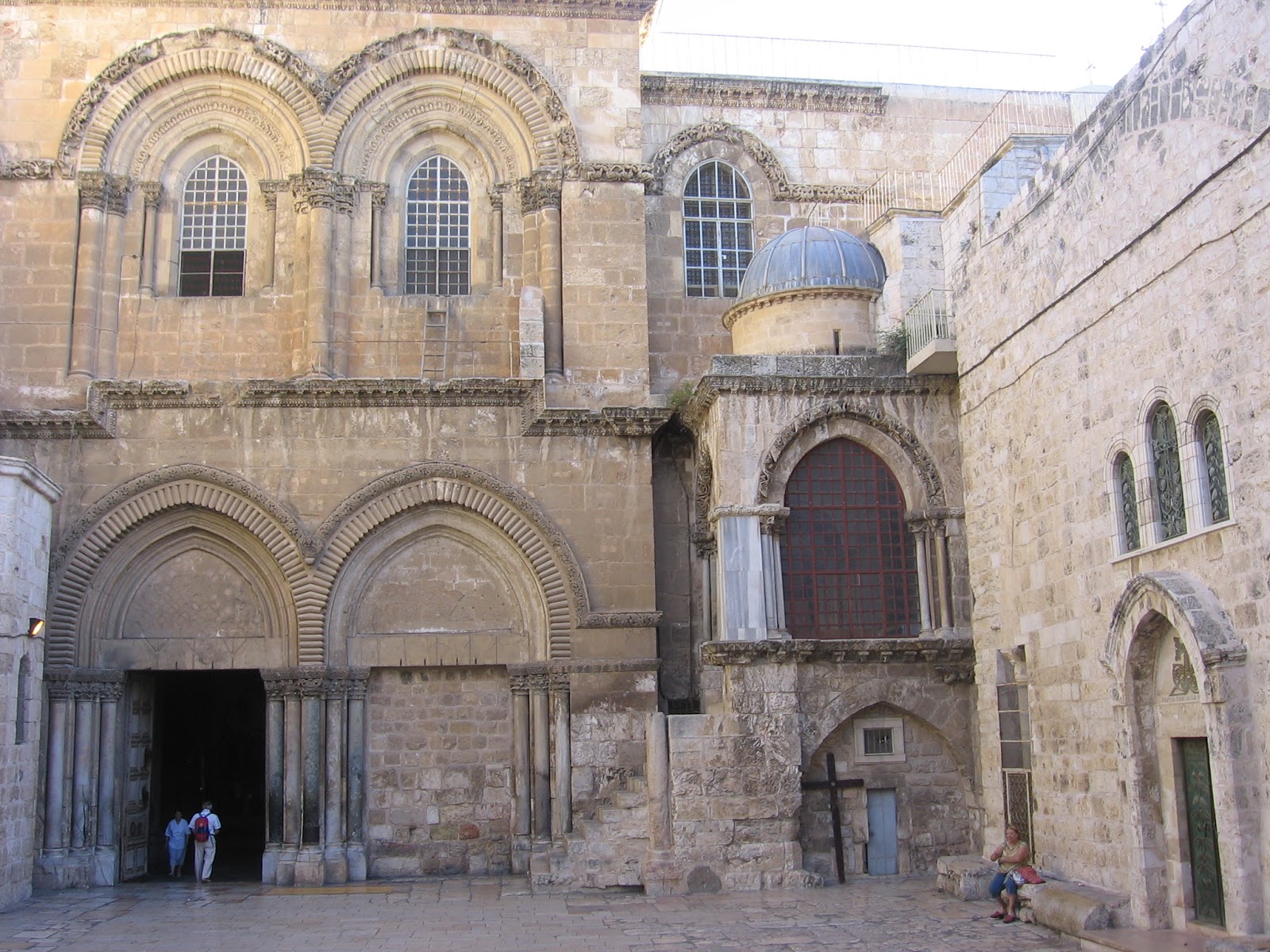
The Church of the Holy Sepulcher
When one goes on pilgrimage, a certain web of grace connects people and places in surprising and unexpected ways.  One of the great surprises of our pilgrimage was in St. Baume, France, at the purported cave of Mary Magdalene.   She is known in the Scriptures as the woman whom Jesus delivered from seven demons, and is also identified as a witness to the death, burial and resurrection of the Lord.  Although she disappears from scriptural tradition after she proclaims the resurrection to the apostles (she is called the Apostle to the Apostles), it is a pious belief that she continued to proclaim the resurrection of Jesus for the rest of her life, even in the face of persecution.  It was even believed that she and her friends were put adrift at sea as a form of execution, and that God saved them and guided them to southern France.   This is how a cave in a remote region of France came to be connected with the initial proclamation of the Gospel. 

Those who climb the mountain at St. Baume find a cave where the Magdalene is said to have lived out a life of quiet penance and contemplation.  A small crypt contains what is believed to be her remains.  Historically, royalty and other government officials came here as an act of penance.  A small plaque indicates Blessed Charles de Foucauld was also drawn to this place as part of his conversion and that intellectuals like the 19th Century Dominican Lacordaire identified this cave as a place of spiritual renewal.  Today, the cave is filled with pilgrims, generally young people, at prayer or at least wanting to pray.  

As for my family and me this summer, we experienced a certain kind of grace that drew us into prayer.  We hiked from the quiet retreat center just below tree-line to the cool dark cave which is just above it.  A certain peaceful silence overtook us as we entered the holy grotto.  Each of us went off by ourselves to be alone in different parts of the cave.  Something in this cave drew us  to prayerful solitude and reflection.

When I came to the reliquary honoring and perhaps containing her remains, I could not help but think of Golgotha and the empty tomb in the Church of the Holy Sepulcher where we had been less than a couple weeks before.  Something about this cave and that empty tomb drew me to contemplate the reality of the resurrection, and the kind of life we want to live when we encounter the Risen Lord.  What if it were true that she who had recognized the Risen Lord had been here?  Would not such a person spend the rest of her life proclaiming the Gospel to the very ends of the earth and praying for the salvation of the world?   After seeing his resurrected eyes gazing on her in love, would she not devote her life to intimacy with him and to making up in her own body what was lacking in his sufferings for the sake of the Church?  If it was not her who had lived in this cave, then it must have been someone like her, for the grace of deep prayer flowed in that cave like the water that dripped from its cracks.  It was the kind of grace which left me wondering whether there might really be something to the highly unlikely but pious scenario connecting St. Baume to Jerusalem.  


August 26, 2010

The Bells on Mt. Tabor

Some of our pilgrims on Mt. Tabor
I started describing our pilgrimage from this summer - what we did each day from when we left on June 12 until our return on August 3. Unfortunately, memory follows its own chronology and the following event is out of sequence. But of our time in Israel, the memory of one moment is so strong, I need to write about it. In fact, it speaks to a certain aspect of prayer that is often overlooked. Prayer is sometimes greatly helped by symbols - not just signs seen, but also holy things heard and felt, sacred symbols like the music of church bells.  Obviously, a symbol points to something beyond itself, indicating a reality greater than it can contain.  A cross symbolizes Christ's work of redemption and the conquest of good over evil.  And although symbols are generally thought of in terms of things we see, when it comes to prayer, all creation takes on symbolic proportions, including sound and especially music.  So I plead your patience while I tell you about the bells of Mt. Tabor, which we did not hear on the second day of our pilgrimage but rather on the third.


Mt. Tabor is the place where the transfiguration of Christ Jesus is traditionally believed to have happened. The very large hill overlooks the Valley of Megiddo, a place of biblical, historical and eschatological battles. Jesus ascended this mount with Peter, James and John. As he did this, light and darkness covered the mountain just as happened to both Elijah and Moses in their encounters with God. What is more, Elijah and Moses appeared with Jesus and they spoke together. Peter asked Jesus whether he could build three booths - perhaps a reference to the Feast of Tabernacles - the September feast by which Israel remembers that God had us live in tents when he brought us out of the Land of Egypt, the feast on which Solomon dedicated the Temple - God's dwelling place, the feast on which pilgrims would journey to the Temple to hear the law, the feast which according to Zechariah the Messiah would make universal for all peoples - the judgment day.   Jesus does not respond to Peter's request.  There was no need to build another earthly tent.  Jesus himself is a new dwelling for God and Man.  The messianic meaning of tents in the wilderness and the Temple of Solomon were fulfilled in Him.  The whole theophany revealed a great Christian truth about prayer: it is to Christ Jesus we go to know the will of God.  The voice of God came out of the bright cloud surrounding Christ and said, "This is my beloved Son. Listen to Him."


The Church of the Transfiguration is beautiful and so are the views from atop Mt. Tabor. Yet comes to my memory most vividly was not what I saw but what I heard: the explosion bells just as we began to descend the front of the church. The deep beautiful tones pealing over head physically resonated deep in the heart. Everyone stopped and let the tolling role right through them. It was an incredible moment of prayer.  It was the Angelus. Each resounding toll was a symbol of the voice of God, that voice echoing out to Peter, James and John - His voice that takes away fear and leaves one's heart in peaceful silence and adoration.

I was reminded of this experience today when I read this from Romano Guardini's Sacred Signs (Michael Glazier: Wilmington, DE (1979) pp. 89ff.):

"News from afar, news of the infinitely limitless God, news of man's bottomless desire, and of its inexhaustible fulfillment. The bells are a summons to those "men of desire" whose hearts are open to far-off things. The sound of bells stirs in us the felling of distance. when they clang out from a steeple rising above a wide plain and their sound is carried to every point of the compass, and on and on to the hazy blue horizon, our wishes follow them as long as they are audible, until it comes home t us that there is no satisfaction of desire in far distant hopes, or indeed in anything outside ourselves. Or, when the pealing bells of a mountain-built church flood the valley with their clamor or send the sound straight up to the zenith, the listener, straining to follow, feels his heart expand beyond its usual narrow limits. Or again, the bell tones in some green glimmering forest may reach us faintly, as from a great distance, too far off to tell from where, and old memories stir, and we strive to catch the sounds and to remember what it is they remind us of. At such moments we have a perception of the meaning of space. We feel the pull of the height, and stretch our wings and try to respond to infinitude. The bells remind us of the world's immensity and man's still more immeasurable desires m and that only in the infinite God we can find our peace. O Lord, this my soul is wider than the world, its longing from depths deeper than any valley, the pain of desire is more troubling than the faint lost of bell notes. Only thyself canst fill so vast an emptiness."

August 13, 2010

The Pilgrimage Continued... still on the first day!

The Copula of the Church of the Annunciation in Nazareth
- built over the place where the Angel Gabriel appeared to Mary


Roman Aquaduct north of Caesarea
Up to the last post, I was sharing about our pilgrimage to the Holy Land.  The first day we set off to Caesarea then Haifa where Mt. Carmel is, then Cana and finally Nazareth.  It was a true whirlwind and when we finally got to our hotel in Tiberius, everyone was exhausted.  Everyone agreed that it was almost too much to take in: the history, the beauty, the culture, and the deep spiritual meaning of each place.  We were submerged in the Scriptures - like a living Gospel, the Holy Land was its own witness to the presence of God in human history and in each of our hearts.

Our group enjoying a view of Haifa
Haifa 
Part of the spirituality of a pilgrimage is learning to be patient with different kinds of hardships.  This particular hardship was disguised.  We were catered to all day, went to some wonderful places of prayer (I will get back to those in the next post), learned a lot from our Arab-Israeli guide - Sami, and ate well.   Before we left, I had explained to everyone that going on a pilgrimage requires a lot of patience.  Now everyone teased me because they felt more spoiled than anything else - they had all expected more spectacular hardships.  At the same time, there was a little sensory overload and, whenever anyone goes into an unfamiliar culture, there are a host of small inconveniences that, even if unnoticed, are a little draining.   So the fatigue was to be expected, and having a little quiet time and personal space welcomed.  No one really complained.
The altar at Cana

There were fourteen of us - mostly friends and family, and some who became friends as we journeyed on our way.  That night, we got together on a terrace overlooking the Sea of Galilee and recounted our favorite adventures.  The experiences were as diverse as the number of pilgrims - so that even if a few mentioned the same place (like the Orthodox Church of Mary's Well), they recalled it for different reasons. Different kinds of moments of prayer touched us all in different ways - and somethings that did not mean much to one pilgrim were very meaningful to another.  Sharing these helped us all pick up on details we missed and more deeply appreciate the gift God was giving us.   There were also experiences that could not quite be articulated, but that we shared in common nonetheless.

Nazareth
There is an analogy here with praying over the Scriptures.  A whole group of people can have the same Biblical passage read and explained to them, but still have their own experience of what God is speaking to them through the Bible.  That is because the Word of God is inexhaustible: both communal-ecclesial and personal - that is it is addressed to the whole Church and at the same time to each of us in ever new ways.   One of the great blessings of going on a pilgrimage with a group is that we experience this same ecclesial and personal grace through the sacred geography disclosed in Scripture and Tradition.  Such graces have the character of a little exchange of love between God and us, and with one another.

August 7, 2010

From Caesarea to Carmel

Our pilgrimage continued from Caesarea to Carmel - where there is a Church honoring Elijah in Haifa at the Stella Maris Carmelite Monastery.  Although the monastery only dates from the 19th Century, Carmel has been considered a special place for meeting God even before prophets Elijah and Elisha lived there during their ministries.   For more on this, check out: http://www.newadvent.org/cathen/03352a.htm.

It is at Mt. Carmel where Elijah challenged and defeated the prophets of Ba'al as told in 1 Kings 18:20-46. Inspired by Elijah's zeal and intimacy with the One true God, a group of crusaders and pilgrims became hermits on the mountain with the blessing of the Patriarch of Jerusalem.  Each hermit lived in a grotto, similar to the one the Church is built over.  These men eventually became known as the Carmelites, a religious community with a special gift for prayer, contemplative prayer in particular.  They were driven out in 1291, but the community never forgot its connection with Carmel even as it spread through Italy, Spain, England and France.  They came back to Carmel in the 19th Century.

Because of their gift for prayer, the Virgin Mary has always been a special patronness of the community.  Our Lady of Mt. Carmel is honored in the Stella Maris church.  In fact, Stella Maris is an ancient title for Mary.  It means "Star of the Sea."  It is the experience of each of us individually but also of the Church historically that sometimes we struggle to follow the Lord.  This is because the Lord tests our hearts to purify them so that we might see Him face to face.  Mary was given the title Star of the Sea with the conviction that just as sailors look to the stars to find their way, Christians can look to Mary, her Scriptural example and maternal concern for each follower of her Son, to find the Lord.  The monastary in fact looks out over the ocean on  the side of Mt. Carmel.  The Church itself is built over the grotto where Elijah is believed to have lived according to tradition.  

This gift of prayer is also related to Elijah.  After confronting the prophets of Ba'al, Elijah despaired of his life.  But the Lord nourished him and prepared him for a special encounter on another mountain, Mt. Horeb south of Israel.  There, like Moses before him, he experiences a theophany, a manifestation of God's presence.  Theophanies have a contemplative character, and this is especially true of Elijah's experience.  This kind of prayer is at the heart of his prophetic mission.  Carmelites seek a similar life of prayer.

"A mighty hurricane split the mountains and shattered Rocks before the Lord.  But the Lord was  not in the hurricane.  And, after the storm, an earthquake.  But the Lord was not in the earthquake.  And after the earthqake, fire.  But the Lord was not in the fire.  And after the fire, a light murmering sound." (1 Kings 19: 11-13)

Contemplative prayer involves two essential moments - it is first of all a listening for the voice of the Lord, an attending to the slightest murmer of the Lord in our hearts.  Moses and Elijah are connected to one another by this experience and their mission to Israel that flows from it - namely, to help Israel know the Lord.  To achieve this kind of attentiveness to the Lord, a secondary moment is necessary, a moment of struggling for and suffering the truth.   In this moment, every falsehood and fantasy must be put to death.  It is a matter of on going repentance - that is thinking with the mind of God rather than clinging to a merely human perspective.  Ba'alism represents a religion based in fantasy and convenient falsehoods.  It provided a sort of social order by providing a kind of myth that helped everyone relate to one another.  This kind of religion, however, is ultimately degrading.  Human dignity requires the truth.  Only the truth raises the dignity of the human person and makes it possible to hear the voice of God.  In other words, to listen to the voice of the Lord requires a spiritual battle, a fight against evil that can be exhausting.  But in this fight, if we are faithful to the end, the Lord provides us the nourishment we need and blesses us with a special gift of friendship with Him.