September 29, 2010

Elisabeth of the Trinity and The Church of Saint-Michel in Dijon, France

St. Michael the Archangel is the patron of the home parish of Elisabeth of the Trinity, the 19th Century Carmelite of Dijon. It is in this parish of Saint-Michel where she went to daily mass. In fact, she lived just blocks away and at the time, the Carmelite Monastery was also in the same neighborhood.

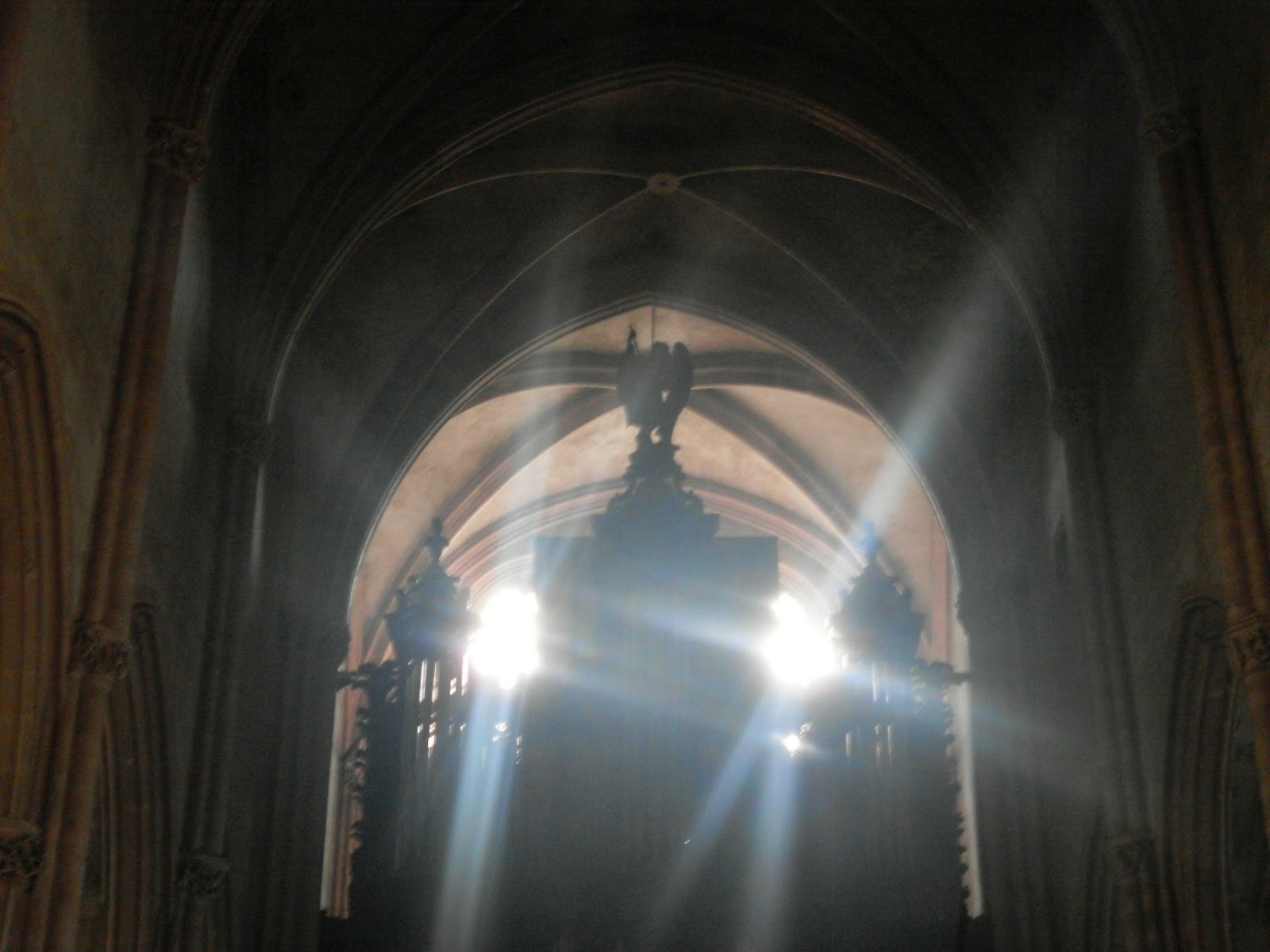
Elisabeth of the TrinityThe Church of Saint-Michel in Dijon, France

It is at this parish that Elisabeth had her first experiences of contemplative prayer.  By this, I mean, she in some sense felt the Lord dwelling inside her heart.  Elisabeth was an award winning pianist, and when asked about how she could perform with so much composure, she explained that as she played, she would think of "Him."  She was astounded at how much God loved her - the love was so excessive and dynamic she was constantly drawn to it.  
Elisabeth's view after receiving Communion at St. Michele


She enjoyed attending to and searching for the loving presence of the Holy Trinity in her heart. This grace seems to have begun with her First Communion, but continued to grow as her prayer deepened. She wanted to consecrate her whole life to the loving service of God. After reading Therese of Lisieux's Story of a Soul, she decided to do this as a Carmelite nun.


In the months before her death in 1906, Blessed Elisabeth wrote her sister, a young wife and mother, a series of daily reflections so that she, too, could enter into the same kind of prayer.  In the very first paragraph, she explains to her sister that the Holy Trinity, the Bosom of the Father, is our true home, the place where our heart is most at rest.  She exhorted her sister to turn her attention to this reality dwelling in her heart, that by seeking the Lord's presence, especially in the painful and broken parts of ourselves, the transforming power of God's love, the power of the Cross, is unleashed in our lives - and we learn to become the praise of God's glory.   This series of reflections is known as one of her major works "Heaven in Faith."

Click here  for my podcasts at DiscerningHearts.com based on Elisabeth's "Heaven in Faith" reflections.

September 27, 2010

St Marie-Madeleine à la Sainte Baume - France


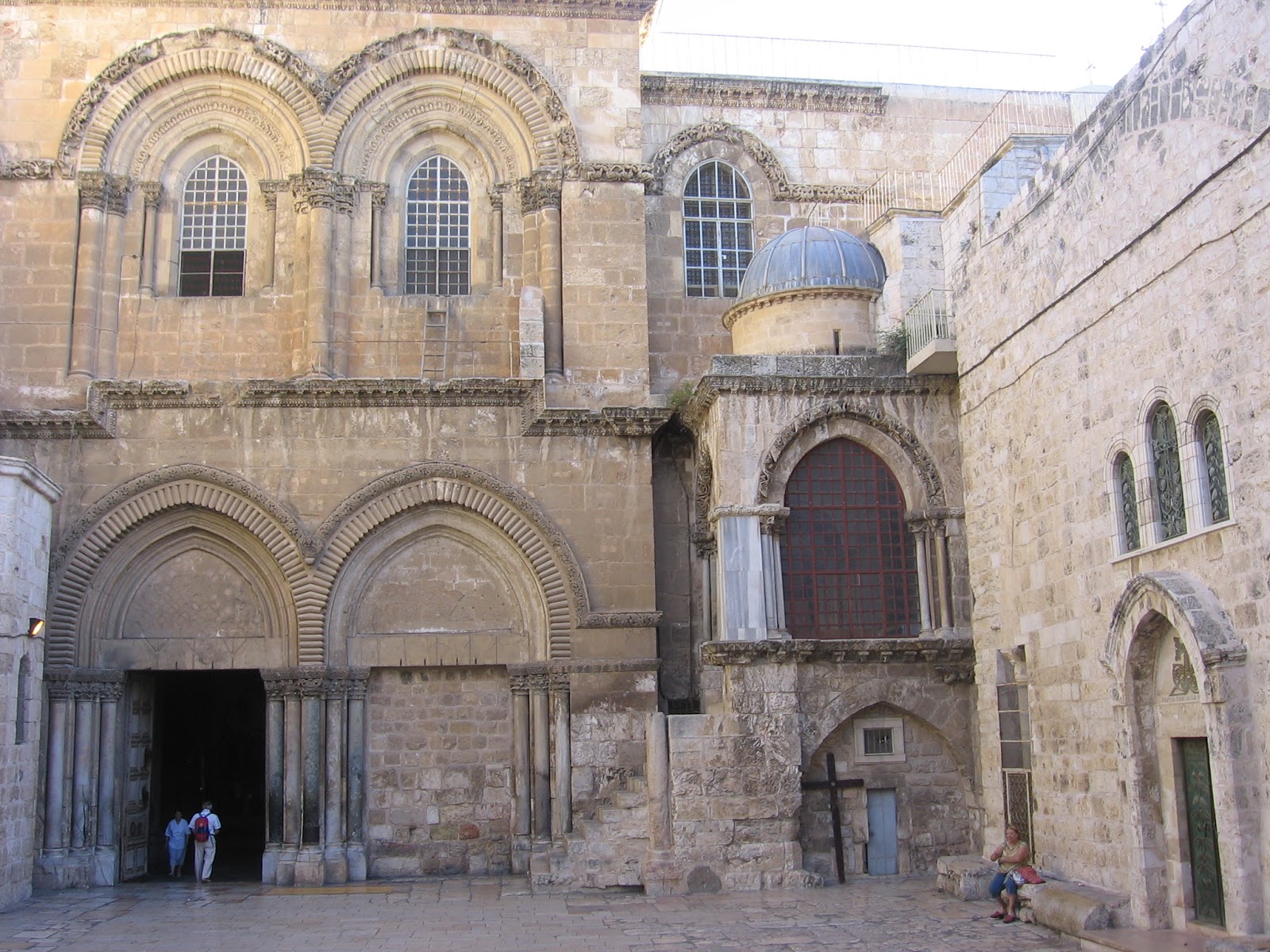
The Church of the Holy Sepulcher
When one goes on pilgrimage, a certain web of grace connects people and places in surprising and unexpected ways.  One of the great surprises of our pilgrimage was in St. Baume, France, at the purported cave of Mary Magdalene.   She is known in the Scriptures as the woman whom Jesus delivered from seven demons, and is also identified as a witness to the death, burial and resurrection of the Lord.  Although she disappears from scriptural tradition after she proclaims the resurrection to the apostles (she is called the Apostle to the Apostles), it is a pious belief that she continued to proclaim the resurrection of Jesus for the rest of her life, even in the face of persecution.  It was even believed that she and her friends were put adrift at sea as a form of execution, and that God saved them and guided them to southern France.   This is how a cave in a remote region of France came to be connected with the initial proclamation of the Gospel. 

Those who climb the mountain at St. Baume find a cave where the Magdalene is said to have lived out a life of quiet penance and contemplation.  A small crypt contains what is believed to be her remains.  Historically, royalty and other government officials came here as an act of penance.  A small plaque indicates Blessed Charles de Foucauld was also drawn to this place as part of his conversion and that intellectuals like the 19th Century Dominican Lacordaire identified this cave as a place of spiritual renewal.  Today, the cave is filled with pilgrims, generally young people, at prayer or at least wanting to pray.  

As for my family and me this summer, we experienced a certain kind of grace that drew us into prayer.  We hiked from the quiet retreat center just below tree-line to the cool dark cave which is just above it.  A certain peaceful silence overtook us as we entered the holy grotto.  Each of us went off by ourselves to be alone in different parts of the cave.  Something in this cave drew us  to prayerful solitude and reflection.

When I came to the reliquary honoring and perhaps containing her remains, I could not help but think of Golgotha and the empty tomb in the Church of the Holy Sepulcher where we had been less than a couple weeks before.  Something about this cave and that empty tomb drew me to contemplate the reality of the resurrection, and the kind of life we want to live when we encounter the Risen Lord.  What if it were true that she who had recognized the Risen Lord had been here?  Would not such a person spend the rest of her life proclaiming the Gospel to the very ends of the earth and praying for the salvation of the world?   After seeing his resurrected eyes gazing on her in love, would she not devote her life to intimacy with him and to making up in her own body what was lacking in his sufferings for the sake of the Church?  If it was not her who had lived in this cave, then it must have been someone like her, for the grace of deep prayer flowed in that cave like the water that dripped from its cracks.  It was the kind of grace which left me wondering whether there might really be something to the highly unlikely but pious scenario connecting St. Baume to Jerusalem.  


September 26, 2010

Blessed are the Poor of Heart

What is the poverty of heart that Jesus deemed true happiness, the blessed way to be, a beatitude?  Our tradition teaches that poverty of heart is a healthy detatchment from things that do not lead us to God.  In other words, when we do not try to satisfy ourselves with frivolous pursuits, comfort, and pleasure, the Lord is saying we are very blessed.   There is space in our hearts for Him to come whenever we renounce anything that does not give him glory.  In my last post, we mentioned how Bernard believed that the soul that realized it was not at peace with itself, that something in its life needed to change, that it needed Jesus, such a soul experienced the blessedness Christ proclaimed for the poor of heart.  It is a painful kind of blessedness: only  in the middle of facing the real suffering eating at one's soul can one find Jesus, Jesus comes in spiritual poverty.

Examples of those who have experienced this kind of blessedness include figures like St. Augustine.  In book 8 of the Confessions, we read how St. Augustine was attracted to living a life dedicated to the pursuit of the truth, which he realize was the pursuit of God himself.  His heart was drawn to this purer way of life.  Now in his thirties, he had recently given up his sex-partner, a woman who had lived with him since they were both teenagers.  Disgusted with his own selfish existence, he wanted to live for something beyond himself and his own pleasure.  At the same time, he was tempted to find another concubine, someone else he could use to satisfy his lust. He was so addicted to sexual pleasure he did not see how he himself could ever give this up.  In the face of this, God offered him chastity.  Chastity was like a beautiful woman calling to him while his lust cleaved to him and  tried to pull him back.   He describes how he wanted what God offered but was not confident that he would really be happy if he had real chastity, and if he could be happily chaste, he was not confident that the Lord would ever really give such chastity to him.  At the same time, he also knew the stories of men less educated and gifted than himself who found the strength to renounce sin and follow the Lord.  He was vexed, torn up inside, yearning for what was good and unable to let go of what was evil.  So in this poverty of heart, he called out to the Lord with tears and loud cries, and the Lord heard him, spoke to him through the Scriptures, and the light of God's confidence flooded his soul.

Poverty of spirit, painful as it is, is a great gift from God because only with this poverty can he come to fill us.

September 10, 2010

Bernard and Facing the Truth about Ourselves

If anyone thinks that what he is asked to do by God is easy, he knows nothing about spiritual warfare.  This is what St. Bernard explained to university students and professors over eight hundred years ago.  It is a good reminder for today.

In his teaching to this lay audience, Bernard appeals to the inner angst which troubles the human heart, a shared human experience.  Indeed, we all have this feeling, at least for a few moments.  In the spiritual traditions of the West, this feeling is attributed to guilt.  How is guilt to be dealt with?   Bernard knows that only the forgiveness of sin can remove guilt and without the removal of sin from our hearts, we are already suffering a living death.  He knows that the Lord died that we might know his loving mercy and forgiveness.  He also knows that unless we face the truth about the sin in our hearts, we cannot know this forgiveness and our life is not really any life at all, but a living death.   Bernard's solution to this dilemma is to turn inward and face the truth about ourselves.

On this point, he invites us to search our memory and to reflect on things that trouble our conscience.  He calls this seeing ourselves as we really are.  As we become aware of what is disturbing us interiorly, he says we discover three things: our reason is blind and weak, our memory is filled with filth, and our will is infested with soars.  We discover to our own disgust that we actually prefer wickedness to what is good to such an extent that we no longer see how much we hurt others or our very selves.

To drive home this experience of ourselves, he describes an interior vexation within our hearts in terms of a marital strife between our reason and our will.   This will, he says, is an ugly old woman covered with festering ulcers who, in a fit of righteous indignation, accuses reason of adultery.  Who has not suffered at least for a few moments resentment when someone who loves us points out a sinful area in our lives?   It is even worse when spouses must admonish one another.   But the worst of all is when we find ourselves vexed at our own mind which has seen a truth that we do not want to accept, that we are not able to accept.  How do we deal with this interior conflict, this spiritual poverty?  Bernard pleads with us to listen to the voice of Christ, "Blessed are the poor of spirit for theirs is the Kingdom of Heaven."

St. Bernard and Conversion

Speaking to a group of scholars and students of the University of Paris in the year 1140, St. Bernard described how the Lord calls us to conversion by revealing the truth about ourselves to ourselves.  He claimed that such conversion was not something that could come about merely by his own words, but rather by the Word of the Lord alone.  He saw himself as a prophet, one proclaiming the voice of God which was already resounding in the hearts of those who were listening.   About twenty of his listeners abandoned their careers on the spot and followed him, becoming monks of Clairvaux.   What did he say which so moved the members of this academic community?

He touched on three key themes in the Catholic Tradition of Christian spirituality which remain as relevant for us today as they were for those who heard them proposed in Paris: the agony of guilt, the certainty of death, and the yearning of the heart for God.  It is true that most spiritualities deal with these realities in one way or another, but the Christian faith proposes a connection between these realities.  Through faith in the Risen Lord, Christians have experienced not only relief from guilt but a healing of the very cause of guilt in us.  In the face of death, they have found a way to cling to an invincible hope which nothing, no amount of suffering or privation in this life, can take away.  Finally, through Christ crucified, they claim to have realized a union with God in love already in this life and feel sustained by the living presence and power of the One they profess to be at the right hand of the Father.

In our next post, we will consider how Christ is the answer to guilt, death and our desire for God in the thought of St. Bernard.